Back to blog home
What Is a Fisheye Camera? 360° Coverage Explained
by Team Rhombus, on August 5th, 2026
Physical SecurityQuick Summary
- A fisheye security camera uses an ultra-wide lens and one image sensor to capture a circular view of a large area.
- When ceiling-mounted, a fisheye camera can record 360-degree coverage without moving parts.
- Dewarping software converts the curved raw image into flat panoramic views or selectable digital views for live and recorded video.
- Fisheye cameras often suit open retail and warehouse floors where continuous coverage matters more than fine detail at long distances.
- Fixed dome cameras cover narrower angles, while mechanical pan-tilt-zoom cameras view one direction at a time.
What a fisheye camera is
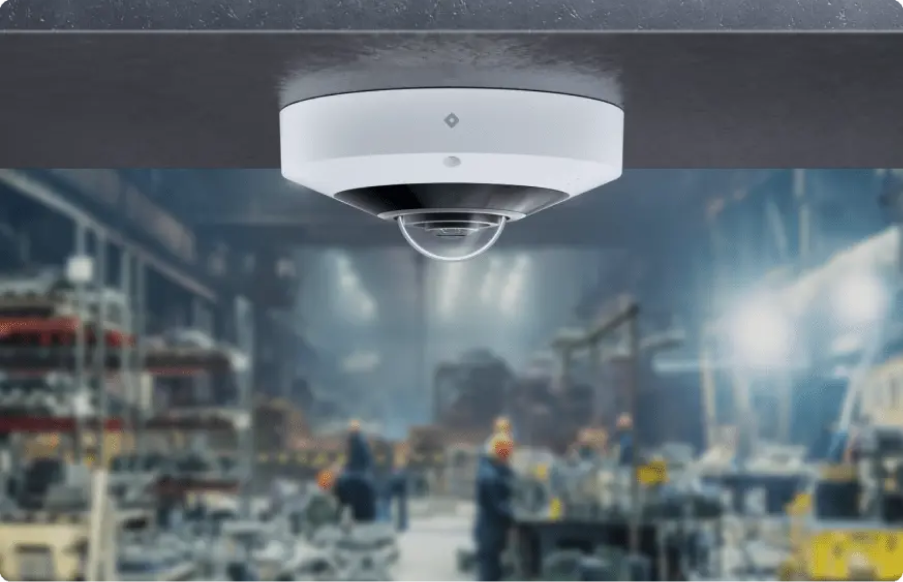
A fisheye camera uses one image sensor and an ultra-wide-angle lens to capture a much broader field of view than a conventional fixed camera. A ceiling-mounted fisheye camera can record a full 360-degree view. A wall-mounted fisheye camera typically covers a wide 180-degree area.
The lens achieves this coverage by bending light from extreme angles onto a flat sensor. Unlike a rectilinear lens, which keeps straight lines looking straight, a fisheye lens curves lines more heavily near the edge of the frame. The raw footage often appears as a circular image with a compressed, distorted perimeter.
A single fisheye security camera can cover several directions at once without physically moving. In an open room, one centrally placed unit may replace several fixed cameras aimed in different directions. The number of cameras you need varies with placement and ceiling height. Obstructions and required image detail also limit each camera’s coverage.
Software makes the curved image easier to view through a process called dewarping. Dewarping transforms the circular recording into flat panoramic views or separate viewing panes while preserving access to the original wide-angle scene.
How 360° coverage and dewarping work
A ceiling-mounted fisheye camera captures light across an extremely wide field of view and projects it onto a single image sensor. The lens bends straight lines near the edge, so the raw footage appears circular and heavily curved. Despite the distortion, the sensor records activity across the entire viewing area at once.
Dewarping software converts that circular image into a flat view. The software maps each pixel to a corrected position based on the lens geometry and the direction the viewer selects. Dewarping makes people and vehicles easier to distinguish from surrounding structures, but it cannot add detail that the sensor did not capture.
Dewarped layouts let you monitor the full area or inspect one region. A panoramic view stretches the surrounding area into a wide strip, while a quad view presents four corrected directions that resemble separate fixed-camera feeds. A single-region view lets you move around and magnify part of the full image.
Digital pan-tilt-zoom, or digital PTZ, crops and enlarges recorded pixels without moving the lens. A mechanical PTZ camera physically changes its viewing direction instead.
Some fisheye systems can dewarp footage during live monitoring or during playback. When the system preserves the full fisheye image, you can inspect any direction in recorded video after an incident. You can do so even when nobody selected that view during the event. Access to the full recording helps investigators follow movement across an open room without relying on a camera operator to point the lens at the right place in advance.
Where fisheye cameras fit best
Fisheye cameras work best in open areas where a central ceiling mount provides clear sightlines in every direction. A single unit can observe activity across a broad floor area without pointing toward one specific zone. Higher mounting can expand the visible footprint, but people and objects occupy fewer pixels as distance increases. Camera resolution and ceiling height affect the visible area, while lighting and required detail determine how much of that area is usable.
Retail sales floors benefit when shelving remains low enough to preserve sightlines. A ceiling-mounted fisheye security camera can follow movement through the sales floor, including display areas and checkout approaches within one continuous recording. You may otherwise need several fixed cameras to cover those directions, and each fixed view can leave gaps between frames.
Warehouses suit fisheye coverage in open staging areas and intersections near loading zones. Tall racks can block the lens, so you may still need fixed cameras inside aisles or behind stored goods. In clear zones, one fisheye view can reduce the number of separate camera angles required to reconstruct an incident.
Parking structures can use fisheye cameras in open parking bays and near intersections or elevators. A fisheye camera’s wide view can capture vehicles and pedestrians entering from different directions. Physical obstructions such as columns and parked vehicles can block parts of the image. Low ceilings can further limit placement options.
Lobbies benefit from a full-room view because people may enter through several doors and move toward reception areas or nearby corridors and elevators. A centrally mounted fisheye camera can preserve those movements in one timeline rather than dividing them among several fixed views. Large atriums may still require additional cameras when mounting height reduces identifiable detail.
One fisheye unit can replace several fixed cameras in a room with clear sightlines and moderate detail requirements. Fixed cameras remain useful when you need a tighter view, such as for faces near entrances and registers or for license plates.
Fisheye vs. dome, PTZ, and multisensor cameras
A ceiling-mounted fisheye camera records a 360-degree scene through one ultra-wide lens, while the other camera types divide coverage or focus on a smaller area. Its ceiling-mounted view preserves activity across the scene, although a narrower camera may capture more detail at a given distance.
A fixed dome camera provides a discreet housing and a conventional field of view. A fixed dome works well when you need a clear view of a doorway or a defined section of a hallway. The fixed dome does not record activity outside its selected frame unless another camera covers that area.
A mechanical pan, tilt, and zoom camera, or PTZ camera, can follow activity and magnify distant subjects. Motors physically reposition its lens, so the camera records whichever direction it faces at that moment. A fisheye camera can provide PTZ-style digital navigation within recorded footage, but digital navigation does not move the lens or increase optical detail.
A multisensor camera places multiple fixed sensors inside one housing. Each sensor covers a separate direction with less edge distortion than a fisheye lens. Installers must aim those sensors carefully because gaps can remain between their fields of view.
| Camera type | Coverage pattern | Moving parts | Ideal use case | Typical blind spots |
|---|---|---|---|---|
| Fisheye | One 180° or 360° ultra-wide view | None | Open rooms that need continuous coverage | Shelving or columns can block parts of the view |
| Fixed dome | One directed, conventional view | None | Defined areas such as entrances or corridors | Anything outside the selected frame |
| Mechanical PTZ | One movable, narrow or zoomed view | Motors reposition the lens | Active tracking across large areas | Areas outside the camera’s current direction |
| Multisensor | Several fixed views from one housing | Usually none | Wide areas around intersections and building corners | Seams between sensors or uncovered angles |
Because placement determines usable video, different areas of a property often require different camera types. Ceiling height and obstructions affect sightlines, while lighting and identification distance affect usable detail.
A modern example: the Rhombus R360S
The Rhombus R360S brings fisheye coverage into a cloud-managed security platform. Its panoramic view captures the surrounding area through one lens, while cloud-managed dewarping converts the curved source image into flatter views that operators can navigate more easily.
The R360S applies its supported AI analytics to panoramic video. Because the R360S retains the wider scene, the Rhombus cloud platform lets you inspect activity outside the view an operator selected and manage footage across locations without a separate on-site video server at each property.
See fisheye coverage in action
Fisheye cameras trade some per-pixel detail for a continuous view of an open space through one installation. The trade-off suits open commercial areas where broad coverage matters more than close detail at every point.
Request a demo to see how fisheye coverage and dewarped views work in a real deployment.
Frequently asked questions
Can fisheye cameras see in the dark?
A fisheye camera can see in low light when the model includes infrared illumination or another night-vision capability. The camera’s specifications and mounting height set its effective range, while ambient light and reflective surfaces affect image detail. Built-in infrared helps you monitor open indoor areas after the lights go out, but complete darkness may reduce detail at the edges.
How many square feet does one fisheye camera cover?
Mounting height and lens angle set the visible area, while resolution and required image detail limit usable coverage. A higher ceiling expands the visible footprint but spreads the available pixels across a larger area. A site plan and test image provide a more reliable coverage estimate than a single square-foot figure.
Does dewarping reduce image quality?
Dewarping rearranges pixels from the circular source image into a flat view, so it cannot create detail that the sensor did not capture. Areas near the outer edge may look softer or more stretched, especially during heavy digital zoom. Higher sensor resolution and suitable placement preserve more usable detail in dewarped views.
Do fisheye cameras need special mounting?
Fisheye cameras usually need careful placement rather than specialized mounting hardware. Ceiling mounting near the center of an open area supports full 360-degree coverage, while wall mounting typically produces a 180-degree panoramic view. Installers should keep the lens’s sightlines clear of nearby obstructions such as hanging fixtures and shelving.
%20--%3e%3csvg%20version='1.1'%20id='Layer_1'%20xmlns='http://www.w3.org/2000/svg'%20xmlns:xlink='http://www.w3.org/1999/xlink'%20x='0px'%20y='0px'%20viewBox='0%200%20110%20110'%20style='enable-background:new%200%200%20110%20110;'%20xml:space='preserve'%3e%3cstyle%20type='text/css'%3e%20.st0{fill:url(%23SVGID_1_);}%20%3c/style%3e%3cg%3e%3clinearGradient%20id='SVGID_1_'%20gradientUnits='userSpaceOnUse'%20x1='25.325'%20y1='766.725'%20x2='84.725'%20y2='707.325'%20gradientTransform='matrix(1%200%200%201%200%20-682)'%3e%3cstop%20offset='0'%20style='stop-color:%23006F94'/%3e%3cstop%20offset='1'%20style='stop-color:%2300C1DE'/%3e%3c/linearGradient%3e%3cpath%20class='st0'%20d='M106.9,47.5L62.5,3.1c-4.1-4.1-10.9-4.1-15,0L3.1,47.5c-4.1,4.1-4.1,10.9,0,15l44.4,44.4%20c4.2,4.2,10.9,4.2,15.1,0L107,62.5C111,58.4,111,51.6,106.9,47.5z%20M55.5,71.2c-9.4,0.3-17-7.3-16.7-16.7C39.1,46,46,39.1,54.5,38.8%20c9.3-0.3,17,7.3,16.7,16.7C70.9,64,64,70.9,55.5,71.2z'/%3e%3c/g%3e%3c/svg%3e)
Related Articles