Back to blog home

Warehouse Safety: How Environmental Sensors Prevent Fire, Smoke, and Air Quality Risks
by Team Rhombus, on April 24th, 2026
Physical SecurityAccording to the NFPA, roughly 1,544 warehouse fires occur each year in the United States, resulting in an average of 2 civilian deaths and 17 injuries annually. Sprinkler systems remain a proven suppression tool, and NFPA data indicates they significantly reduce fire-related fatalities and property damage when present and operational. But sprinklers activate after a fire has already started, and they tell you nothing about the air quality hazards building up between incidents. Environmental sensors fill that gap by catching threats early, often minutes before flames or toxic conditions reach a dangerous threshold.
Why Warehouses Face Elevated Environmental Risk
Warehouses are structurally different from offices or retail spaces, and those differences compound environmental risk. High ceilings (often 30 feet or more), vast open floor plans, dense racking systems, and mixed inventory create conditions where smoke disperses, heat stratifies, and hazardous gases accumulate in unpredictable patterns. Many facilities also operate with minimal staffing during overnight or weekend shifts, which means environmental changes can go unnoticed for hours. A cloud-managed physical security platform that combines sensors and cameras gives operations teams continuous visibility into these conditions, even when no one is on-site.
Common Causes of Warehouse Fires
The most frequent ignition sources in warehouse environments are combustible dust, electrical faults, equipment malfunction, flammable liquid storage, and hot work such as welding or cutting. Dust accumulation on horizontal surfaces, racking, and HVAC systems is particularly dangerous because it can ignite from a single spark. Forklift battery charging areas and aging electrical panels add another layer of risk that standard safety inspections may only catch periodically.
The Limits of Traditional Fire Detection
Conventional spot-type smoke detectors perform well in standard commercial spaces, but they are far less effective in warehouses with 30- to 40-foot ceilings. Smoke from a smoldering fire dilutes and cools as it rises through large vertical spaces, often failing to trigger these detectors until the fire is well established. This delay is why fire protection engineers recommend alternative detection methods for large-volume, high-bay environments.
Types of Environmental Sensors for Warehouse Safety
A single sensor type cannot address every warehouse hazard. Effective monitoring requires layering multiple sensor categories, each tuned to specific threats.
Smoke Detection Sensors
For large open spaces, beam smoke detectors and aspirating smoke detection (ASD) systems are the preferred options. Beam detectors project an infrared beam across a wide area and trigger when smoke obscures the beam, making them well suited for high-ceiling environments. ASD systems actively draw air samples through a pipe network to a central detection unit, providing very early warning of smoke particles, sometimes detecting threats before visible smoke forms.
Heat Sensors
Heat detectors come in two main types: fixed-temperature and rate-of-rise. Fixed-temperature detectors activate when a set threshold (commonly 135°F or 200°F) is reached. Rate-of-rise detectors trigger when the temperature climbs faster than a defined rate, typically 12 to 15°F per minute, which makes them effective at catching fast-developing fires that might not immediately produce heavy smoke.
Air Quality and Gas Sensors
CO sensors detect carbon monoxide from forklifts, generators, and other combustion equipment. CO2 sensors monitor carbon dioxide levels, which can indicate ventilation problems or unsafe worker conditions. VOC sensors flag volatile organic compounds from solvents, adhesives, and cleaning agents stored on-site. Particulate sensors measuring PM2.5 and PM10 track fine dust and combustion byproducts, which is critical in facilities that handle powders, packaging materials, or operate diesel equipment indoors. Deploying environmental sensors across these categories gives warehouse teams continuous air quality data rather than periodic manual checks.
Temperature and Humidity Sensors
Temperature and humidity monitoring protects both people and inventory. In cold storage facilities, a sensor alerting on a compressor failure can save thousands of dollars in spoiled product. In standard warehouses, humidity spikes can damage electronics, corrode metal components, or promote mold growth on paper and textile goods.
What to Look for in a Warehouse Environmental Monitoring System
When evaluating warehouse monitoring systems, facilities managers and security directors should prioritize four capabilities.
Real-Time Alerts and Remote Visibility
Sensors should push instant notifications to mobile devices and email when thresholds are breached. Cloud-based access ensures that operations leaders and security teams can monitor conditions from anywhere, which is especially valuable during off-hours when on-site staff may be limited or absent.
Integration with Security Cameras
Pairing sensor alerts with camera feeds provides visual verification of what triggered the alarm. A smoke alert paired with a live camera view lets a remote operator distinguish between an actual fire and a dust cloud from a forklift in seconds, dramatically reducing false alarm response costs and speeding up decision-making. Systems that layer AI-powered analytics on top of camera feeds can further automate threat classification, flagging events that match fire or smoke signatures without waiting for a human to review every alert.
Centralized, Cloud-Managed Platform
Multi-site operations benefit from a single dashboard where sensor readings, camera feeds, and access control status are visible in one place. Automatic firmware updates remove the maintenance burden of manually patching devices across multiple locations, which is a common failure point with legacy on-premise systems.
OSHA and NFPA Compliance Support
Your monitoring system should support compliance with NFPA 72 (National Fire Alarm and Signaling Code) and OSHA 29 CFR 1910.38 (Emergency Action Plans).
NFPA 72 governs how fire alarm and detection systems are designed, installed, and maintained. In practical terms, it requires that alarm notification appliances (horns, strobes, mass notifications) reach all occupants, that detection devices are inspected and tested on defined schedules, and that all system events are logged with timestamps for audit purposes. Facilities must keep records of inspections, testing dates, and any deficiencies found during maintenance.
OSHA 29 CFR 1910.38 requires employers to have a written emergency action plan that includes procedures for reporting fires, evacuation routes, and methods for accounting for all employees after an evacuation. Employers must also designate and train employees to assist in safe evacuation and must review the plan with each employee when it is first developed or when the employee is initially assigned to a job.
Audit trails, historical data logs, and automated reporting make it far easier to document compliance during inspections rather than scrambling to compile records manually. A monitoring system that timestamps every sensor event and stores historical readings in the cloud gives facilities teams ready-made documentation for both NFPA 72 inspection records and OSHA emergency action plan reviews.
How Integrated Sensor-Camera-Access Control Systems Work
The trend in commercial fire and environmental safety is moving away from siloed systems and toward unified platforms where sensors, cameras, and access control work as a coordinated response layer.
From Alert to Action: A Unified Safety Response
The sequence works like this. An environmental sensor detects abnormal conditions, such as a rapid temperature spike or elevated smoke particle count, and sends an immediate alert. A nearby camera automatically pulls up a live feed so an operator can visually confirm the threat. If the situation warrants it, access control locks down the affected zone to prevent entry while emergency responders are dispatched.
This sensor-to-camera-to-access-control chain compresses response time from minutes to seconds. It also reduces false alarm fatigue, since visual confirmation prevents unnecessary evacuations or fire department calls that erode trust in the system over time.
Rhombus: Cloud-Managed Sensors Built for Commercial Environments
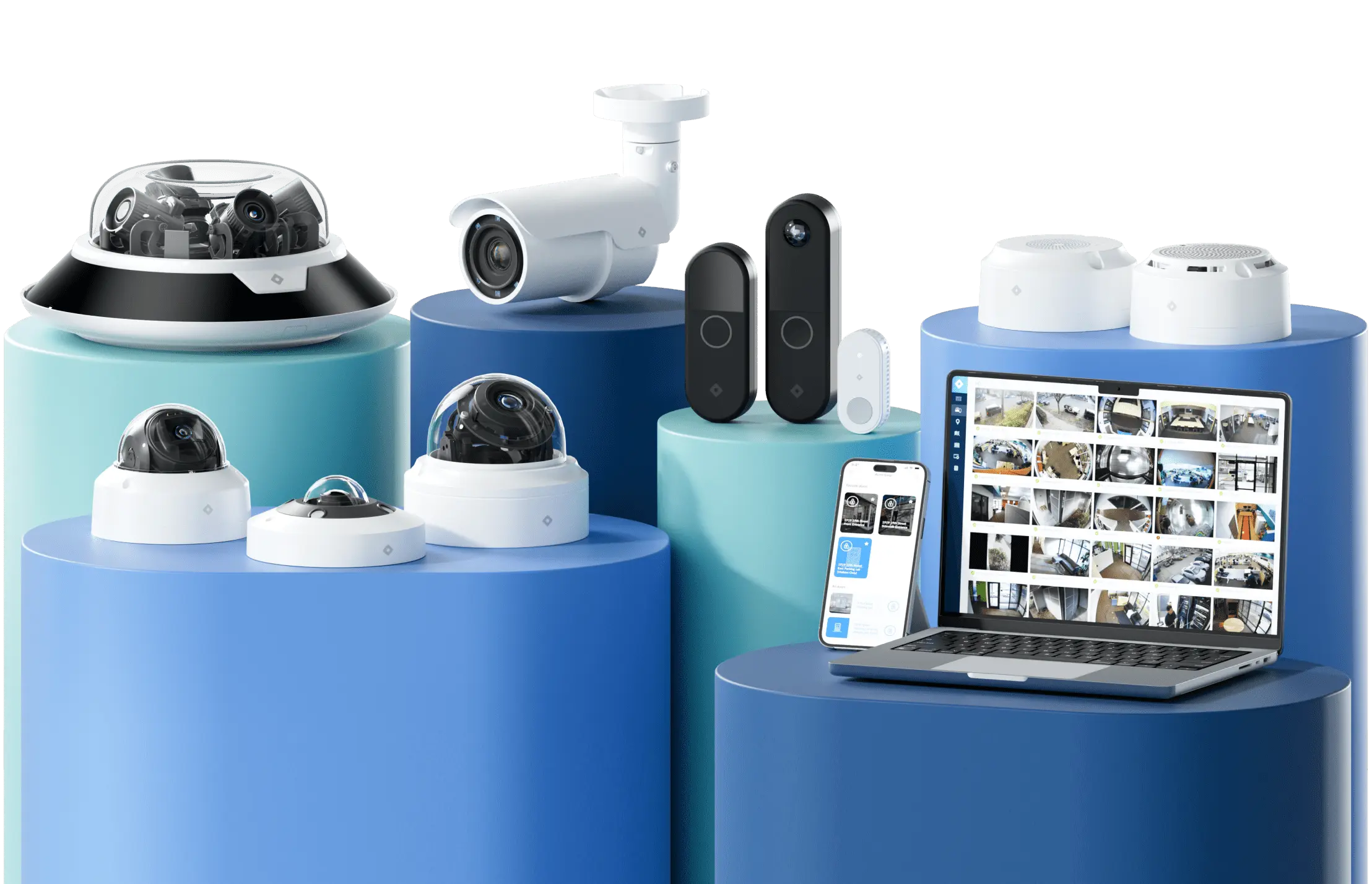
Rhombus offers a cloud-managed sensor platform that natively integrates environmental sensors with security cameras and access control. Smoke, temperature, humidity, and air quality data flows into the same dashboard as video feeds, so a single alert can trigger both a notification and a camera clip for verification. Rhombus is managed entirely through the cloud, with automatic firmware updates and no on-premise server requirements.
For warehouse and industrial environments, native integration reduces reliance on third-party middleware layers and custom API configurations. Sensors, cameras, and door controllers share one console, which simplifies both daily monitoring and incident investigation.
Sensor Placement Best Practices for Warehouses
Where you place sensors is just as important as which sensors you choose. Five zones in a typical warehouse demand dedicated coverage.
- Loading docks and receiving areas: Frequent door openings create temperature swings and introduce outside particulates. Smoke and heat sensors here catch fires that start near idling trucks or discarded packing materials.
- Charging stations and electrical rooms: Battery charging generates heat and, in some chemistries, off-gases. CO and temperature sensors provide early warning of thermal runaway or electrical faults.
- Chemical and flammable storage zones: VOC and particulate sensors detect leaks or spills before vapor concentrations reach dangerous levels. Heat sensors add a second layer of fire detection.
- High-rack storage aisles: Smoke stratifies in narrow aisles between tall racks. Beam detectors or ASD systems mounted at intermediate heights catch smoke that ceiling-mounted detectors would miss.
- Server rooms and control areas: Temperature and humidity sensors protect sensitive electronics. Early smoke detection in these confined spaces can prevent data loss and operational downtime.
Frequently Asked Questions
- What types of sensors do warehouses need? Most warehouses benefit from a combination of smoke detection sensors (beam detectors or aspirating systems for high ceilings), heat detectors, CO and CO2 sensors, VOC sensors, particulate monitors, and temperature and humidity sensors. The right mix depends on your inventory type, ceiling height, and operational hazards. Facilities storing flammable liquids or chemicals will need VOC and gas detection, while cold storage operations should prioritize temperature monitoring with immediate alerting.
- How do environmental sensors integrate with security cameras? In a unified system, an environmental sensor alert automatically triggers the nearest camera to pull up a live feed or recorded clip. This lets a remote operator visually confirm whether the alert reflects an actual threat or a benign event like dust kicked up by equipment. The pairing eliminates guesswork and reduces costly false alarm responses, since operators can verify conditions before dispatching emergency services.
- What compliance standards apply to warehouse fire detection? The two primary standards are NFPA 72, which covers fire alarm system design, installation, testing, and maintenance, and OSHA 29 CFR 1910.38, which requires written emergency action plans including fire reporting procedures, evacuation routes, and employee training. Both standards require documented records. NFPA 72 mandates timestamped logs of system events and testing, while OSHA requires that emergency plans be reviewed with employees and updated as conditions change.
- How often should warehouse sensors be tested or calibrated? Testing frequency varies by sensor type and applicable codes. NFPA 72 specifies testing intervals for fire alarm devices, with most smoke and heat detectors requiring functional testing at least annually and some components requiring semiannual or quarterly checks. Air quality sensors (CO, CO2, VOC) should be calibrated according to manufacturer recommendations, which is typically every 6 to 12 months. Many cloud-managed systems run automated diagnostic checks that flag sensor health issues between scheduled maintenance windows.
- What is the difference between a smoke detector and an environmental monitoring sensor? A smoke detector is a single-purpose device designed to sense smoke particles and trigger an alarm. An environmental monitoring sensor is a broader category that can measure temperature, humidity, air quality (CO, CO2, VOC, particulates), and other atmospheric conditions. Environmental sensors provide continuous data and trend tracking rather than simple binary alarms, which gives facilities teams the ability to spot developing problems, such as rising CO levels or gradual humidity increases, before they become safety incidents.
Conclusion
Environmental sensors give warehouse teams the ability to detect fires, air quality issues, and environmental shifts before they escalate into safety incidents or costly damage. When those sensors feed into a unified system alongside cameras and access control, response times shrink and compliance documentation becomes automatic rather than manual.
If you are evaluating warehouse monitoring options, request a demo from Rhombus to see how integrated environmental sensors, cameras, and access control work within a single cloud-managed platform.
%20--%3e%3csvg%20version='1.1'%20id='Layer_1'%20xmlns='http://www.w3.org/2000/svg'%20xmlns:xlink='http://www.w3.org/1999/xlink'%20x='0px'%20y='0px'%20viewBox='0%200%20110%20110'%20style='enable-background:new%200%200%20110%20110;'%20xml:space='preserve'%3e%3cstyle%20type='text/css'%3e%20.st0{fill:url(%23SVGID_1_);}%20%3c/style%3e%3cg%3e%3clinearGradient%20id='SVGID_1_'%20gradientUnits='userSpaceOnUse'%20x1='25.325'%20y1='766.725'%20x2='84.725'%20y2='707.325'%20gradientTransform='matrix(1%200%200%201%200%20-682)'%3e%3cstop%20offset='0'%20style='stop-color:%23006F94'/%3e%3cstop%20offset='1'%20style='stop-color:%2300C1DE'/%3e%3c/linearGradient%3e%3cpath%20class='st0'%20d='M106.9,47.5L62.5,3.1c-4.1-4.1-10.9-4.1-15,0L3.1,47.5c-4.1,4.1-4.1,10.9,0,15l44.4,44.4%20c4.2,4.2,10.9,4.2,15.1,0L107,62.5C111,58.4,111,51.6,106.9,47.5z%20M55.5,71.2c-9.4,0.3-17-7.3-16.7-16.7C39.1,46,46,39.1,54.5,38.8%20c9.3-0.3,17,7.3,16.7,16.7C70.9,64,64,70.9,55.5,71.2z'/%3e%3c/g%3e%3c/svg%3e)
Related Articles