Back to blog home
The Operations Tool Hiding in Your Security System: Video as Continuous-Improvement Data
by Team Rhombus, on June 23rd, 2026
Physical SecurityEvery continuous improvement program eventually reaches the same point.
The dashboards are full of data. KPIs are being tracked. Reports arrive on time.
Yet the same operational problems keep resurfacing.
Not because organizations lack information—but because they lack visibility into what actually happened.
Most operational metrics answer what. They rarely explain why.
Across utility operations, that “why” lives in hundreds of places: substations, storage yards, fleet facilities, regulator stations, loading areas, and remote assets spread across thousands of square miles. Every day, people adapt to changing conditions, equipment behaves differently than expected, and processes evolve in ways that no dashboard captures.
But there is a record of nearly all of it.
Most organizations simply don’t think of it as operational data.
For years, security cameras have been deployed to deter theft, protect employees, and investigate incidents after they occur. Once installed, they become part of the background infrastructure—important when something goes wrong, largely ignored when everything appears to be working.
That perspective misses one of the most valuable datasets most organizations already own.
Because security cameras don’t just record incidents.
They record operations.
Video Documents How Work Actually Happens
Every camera observes something larger than security.
It captures equipment movement, vehicle traffic, material handling, crew coordination, access patterns, site congestion, maintenance activities, and the countless process variations that occur throughout the day.
Viewed through an operational lens, video becomes something entirely different.
It becomes a continuous record of how work is actually performed.
Organizations outside the utility industry are already beginning to recognize this shift. Recent industry research found that nearly 40 percent of organizations now use video systems to generate operational or business intelligence—not solely for investigations.
Utilities are particularly well positioned to benefit.
Many have spent years using cameras to remotely monitor equipment and facilities alongside their security responsibilities. The infrastructure already exists. The opportunity is no longer collecting more data—it’s extracting more value from data that’s already being collected.
Seeing Root Causes Instead of Reconstructing Them
When an equipment failure, near miss, or process breakdown occurs, investigations often begin the same way.
Teams interview employees. Review logs. Compare timelines. Attempt to reconcile conflicting accounts of what happened.
It works, but it’s slow.
And memory is rarely perfect.
Video changes the conversation.
Instead of reconstructing events, teams observe them.
Discussions become less about whose recollection is correct and more about understanding what the operation actually looked like in real time.
That creates faster investigations, more objective findings, and ultimately better decisions about how to improve the process—not simply document the incident.
Closing the Gap Between Procedures and Reality
Every organization has documented procedures describing how work should happen.
Field operations rarely unfold exactly that way.
Crews adapt to weather, equipment conditions, staffing levels, customer demands, and countless variables that written procedures cannot anticipate.
Safety researchers often describe this as the difference between work-as-imagined and work-as-done.
Continuous improvement exists to close that gap.
The challenge is that you cannot improve behavior you cannot observe.
Reviewing operational video across multiple sites allows improvement teams to compare how the same task is performed under different conditions. Sometimes the procedure needs refinement. Sometimes one district has developed a better workflow that should become the new standard. Other times the process itself unintentionally encourages shortcuts.
The objective is never to evaluate individuals.
It’s to understand how the system influences behavior.
Organizations that approach video this way gain operational insight.
Organizations that use it primarily to monitor employees often gain resistance instead.
Patterns Matter More Than Individual Incidents
One recording explains one event.
Hundreds of recordings begin to explain the system.
When operational video is considered alongside maintenance records, equipment failures, access logs, safety reports, and production metrics, recurring patterns begin to emerge.
The same congestion points.
The same workflow bottlenecks.
The same environmental conditions.
The same procedural breakdowns.
Instead of treating every incident as an isolated problem, organizations can identify the conditions that repeatedly create risk.
This mirrors a broader shift happening throughout the utility industry.
As Southern Company Gas CEO Kim Greene has described it, the industry is “evolving safety into a science”—using data to understand systemic risk before incidents occur.
Operational video becomes another source of evidence in that larger effort.
Not replacing sensors, inspections, or reporting systems.
Completing the picture they provide.
Making Operational Video Practical
The challenge isn’t collecting video.
It’s making it usable.
Traditional video systems were designed as archives. Footage lives on individual recorders, spread across dozens or hundreds of locations, making meaningful analysis slow and time-consuming.
Operational teams rarely have the time—or the desire—to manually search through hours of recordings.
To function as an operational dataset, video needs to work more like every other modern source of business intelligence.
It should be searchable.
Accessible from anywhere.
Available across every location.
Easy to correlate with the operational metrics teams already use to measure performance.
Cloud-managed platforms make this possible by centralizing video across sites and enabling rapid search, remote access, and organization-wide visibility.
The technology itself isn’t the breakthrough.
The ability to treat video as operational information is.
Security Systems Are Becoming Operational Systems
Organizations rarely invest in physical security with continuous improvement in mind.
They invest to protect people, facilities, and assets.
But once those systems are in place, they begin documenting something much larger: the daily operation of the business itself.
For continuous improvement teams, that creates an opportunity.
Instead of asking what another dashboard can measure, they can begin asking what operational questions their existing video can answer.
Because one of the richest sources of operational insight may not require deploying another sensor or building another report.
It may already be recording everything they need to see.
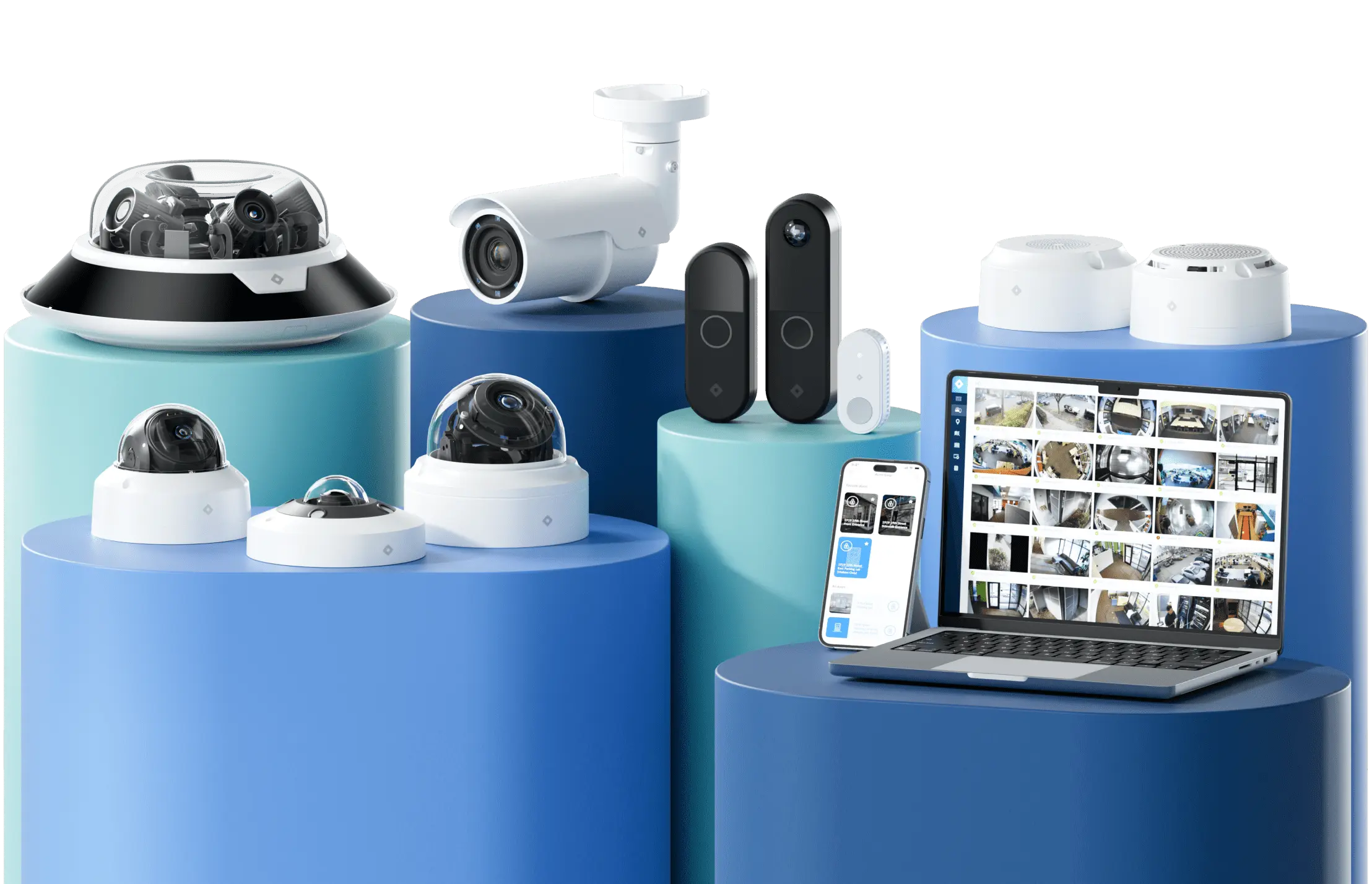
See How Rhombus Turns Security Video Into Operational Intelligence
Modern physical security platforms can do more than protect facilities—they can help organizations better understand how work gets done.
With AI-powered search, centralized cloud management, and unified visibility across every location, Rhombus helps operations and security teams uncover insights that improve efficiency, accelerate investigations, and strengthen day-to-day operations.
Learn how organizations are using cloud-managed physical security to move beyond incident response and unlock operational intelligence.
Schedule a personalized demo: https://www.rhombus.com/demo/
%20--%3e%3csvg%20version='1.1'%20id='Layer_1'%20xmlns='http://www.w3.org/2000/svg'%20xmlns:xlink='http://www.w3.org/1999/xlink'%20x='0px'%20y='0px'%20viewBox='0%200%20110%20110'%20style='enable-background:new%200%200%20110%20110;'%20xml:space='preserve'%3e%3cstyle%20type='text/css'%3e%20.st0{fill:url(%23SVGID_1_);}%20%3c/style%3e%3cg%3e%3clinearGradient%20id='SVGID_1_'%20gradientUnits='userSpaceOnUse'%20x1='25.325'%20y1='766.725'%20x2='84.725'%20y2='707.325'%20gradientTransform='matrix(1%200%200%201%200%20-682)'%3e%3cstop%20offset='0'%20style='stop-color:%23006F94'/%3e%3cstop%20offset='1'%20style='stop-color:%2300C1DE'/%3e%3c/linearGradient%3e%3cpath%20class='st0'%20d='M106.9,47.5L62.5,3.1c-4.1-4.1-10.9-4.1-15,0L3.1,47.5c-4.1,4.1-4.1,10.9,0,15l44.4,44.4%20c4.2,4.2,10.9,4.2,15.1,0L107,62.5C111,58.4,111,51.6,106.9,47.5z%20M55.5,71.2c-9.4,0.3-17-7.3-16.7-16.7C39.1,46,46,39.1,54.5,38.8%20c9.3-0.3,17,7.3,16.7,16.7C70.9,64,64,70.9,55.5,71.2z'/%3e%3c/g%3e%3c/svg%3e)
Related Articles