Back to blog home
More Storage, More Flexibility: What's New with the Rhombus N100 Relay Core
by Scott Wisotsky, on September 1st, 2026
Product UpdatesIntroduction
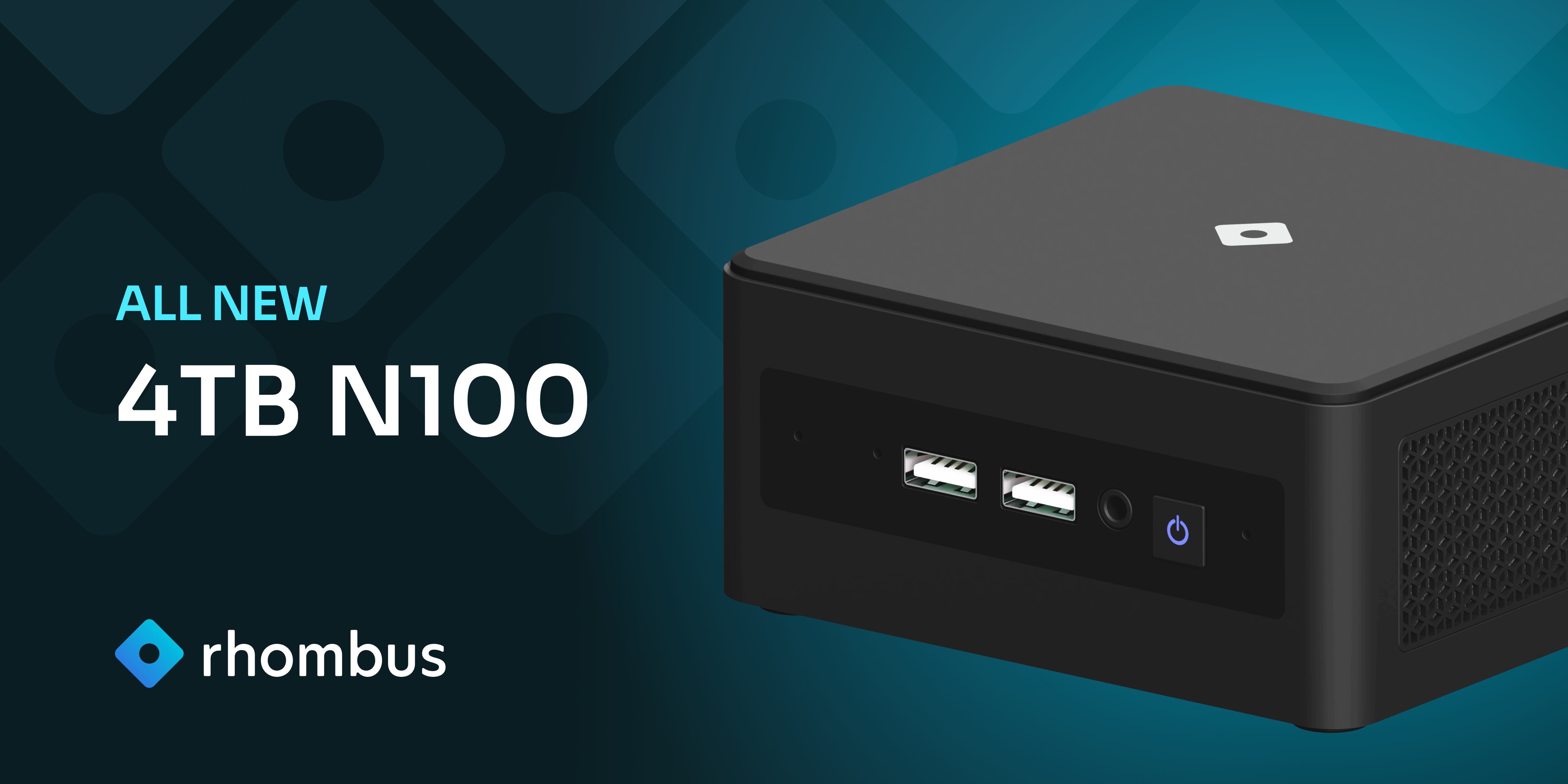
The Relay Core N100 has always given organizations a way to bring existing RTSP and ONVIF cameras onto the Rhombus platform without ripping and replacing hardware. Now the N100 can provide 4TB of onboard storage, doubling the previous 2TB baseline and unlocking up to 40 days of video storage per camera. Additionally, every new N100 also ships with a Dual NIC and dedicated second Ethernet port giving organizations with segregated networks a cleaner, more secure way to connect 3rd party cameras to the cloud.
Quick Refresher: Rhombus N100 Relay Core
The N100 Relay Core is a compact on-premise device that turns existing 3rd party RTSP-streaming cameras into smart, cloud-managed cameras on the Rhombus platform. It ingests third-party camera feeds, encrypts video and cloud communication once footage reaches the device, and gives organizations centralized visibility, remote access, and AI-powered analytics across a mixed fleet of Rhombus and non-Rhombus cameras. Each N100 device supports up to 10 cameras at 1080p, works with mechanical PTZ cameras, and is backed by a 5-year Rhombus warranty.
In short: the N100 Relay Core lets organizations modernize their security stack on their own timeline, without tossing out cameras that still work.
Double the Storage: From 20 Days to 40
Longer video storage isn’t a ‘nice-to-have’ - it’s often the law. The N100 previously only shipped with 2TB of onboard storage, which supported roughly 20 days of retention per camera depending on resolution, bitrate, and motion. The new 4TB option doubles that capacity, supporting up to 40 days of storage per camera under the same conditions.
Why does that matter? Because “how long do you need to keep footage” isn’t just a question for many organizations. It’s a compliance regulation, and the answer is frequently 30 days or more.
Where 40 Days of Video Storage Is Often Required
Video Retention requirements vary by state and industry, and organizations should always confirm current requirements with their own legal counsel or regulator. That said, a look across a few industries shows how common 30 day (and longer) retention windows have become:
Cannabis dispensaries
Video retention is one of the most consistently enforced requirements in cannabis regulation, and it varies widely by state and license type. Colorado’s cannabis surveillance rules call for a minimum of 40 days of video retention. Other states range anywhere from roughly two weeks to 90 days, with many in the 30-to-45-day range. Dispensary operators generally build their video retention policy around the strictest requirement they’re subject to, since regulators, auditors, and insurers can all request footage well after an incident occurs.
State specific regulations
Many states have specific regulations and statues around video surveillance camera storage in different industries such as Florida’s Statute 768.0706. This Florida statute gives multifamily property owners a presumption against liability for third-party criminal acts when they substantially implement a set of security measures, including a camera system at points of entry and exit that keeps footage retrievable for at least 30 days.
Casinos
Gaming surveillance regulations are set state by state through each jurisdiction’s gaming commission, and requirements differ by camera type and incident classification. Some states set relatively short baselines for routine floor coverage, but require much longer retention for footage involving detentions, questioning, or suspicious activity. Casinos also frequently retain footage well beyond the regulatory floor simply because gaming investigations and disputes can surface weeks after the fact.
Healthcare and pharmaceuticals
Pharmacies handling controlled substances sit at the intersection of state board of pharmacy rules and DEA security expectations. Some states set an explicit minimum such as Washington, which requires at least 30 calendar days of high-quality recorded surveillance for certain pharmacy operations.
Other regulated environments
Video storage requirements show up in plenty of other places such as banking and financial institutions, self-storage facilities managing liability and theft claims, and K-12 schools balancing incident review windows with state recordkeeping expectations. The common thread is that 20 days of video storage is rarely enough margin once you factor in weekends, reporting delays, and investigations that don’t start the moment an incident happens.
Also New: A Second Ethernet Port on Every N100
Alongside the storage upgrade, every new N100 (2TB and 4TB) now ships with a Dual NIC and dedicated second Ethernet port.
Previously, organizations with segregated networks (where cameras live on a private, isolated subnet and internet access is delivered through a separate subnet) often needed a USB network adapter to get the N100 talking to both networks at once. It worked, but it added a point of complexity to the deployment.
With two built-in ports, that workaround goes away:
- One Ethernet port is LAN-only and connects directly to the on-site camera network, keeping camera traffic local and off the internet-facing network. This is effectively replacing the role a traditional NVR would have played on that same segregated subnet.
- The second Ethernet port connects to the internet-facing switch, handling communication with the Rhombus cloud without exposing the internal camera network.
The result is a cleaner, more secure deployment for organizations that already separate their camera infrastructure from their general network.
Learn More
Same compact form factor, same plug-and-play deployment, now with double the storage and two ethernet ports for simpler networking.
Learn more about the Relay Core N100 at rhombus.com/cameras/relay-connector/n100.
%20--%3e%3csvg%20version='1.1'%20id='Layer_1'%20xmlns='http://www.w3.org/2000/svg'%20xmlns:xlink='http://www.w3.org/1999/xlink'%20x='0px'%20y='0px'%20viewBox='0%200%20110%20110'%20style='enable-background:new%200%200%20110%20110;'%20xml:space='preserve'%3e%3cstyle%20type='text/css'%3e%20.st0{fill:url(%23SVGID_1_);}%20%3c/style%3e%3cg%3e%3clinearGradient%20id='SVGID_1_'%20gradientUnits='userSpaceOnUse'%20x1='25.325'%20y1='766.725'%20x2='84.725'%20y2='707.325'%20gradientTransform='matrix(1%200%200%201%200%20-682)'%3e%3cstop%20offset='0'%20style='stop-color:%23006F94'/%3e%3cstop%20offset='1'%20style='stop-color:%2300C1DE'/%3e%3c/linearGradient%3e%3cpath%20class='st0'%20d='M106.9,47.5L62.5,3.1c-4.1-4.1-10.9-4.1-15,0L3.1,47.5c-4.1,4.1-4.1,10.9,0,15l44.4,44.4%20c4.2,4.2,10.9,4.2,15.1,0L107,62.5C111,58.4,111,51.6,106.9,47.5z%20M55.5,71.2c-9.4,0.3-17-7.3-16.7-16.7C39.1,46,46,39.1,54.5,38.8%20c9.3-0.3,17,7.3,16.7,16.7C70.9,64,64,70.9,55.5,71.2z'/%3e%3c/g%3e%3c/svg%3e)
Related Articles