Back to blog home
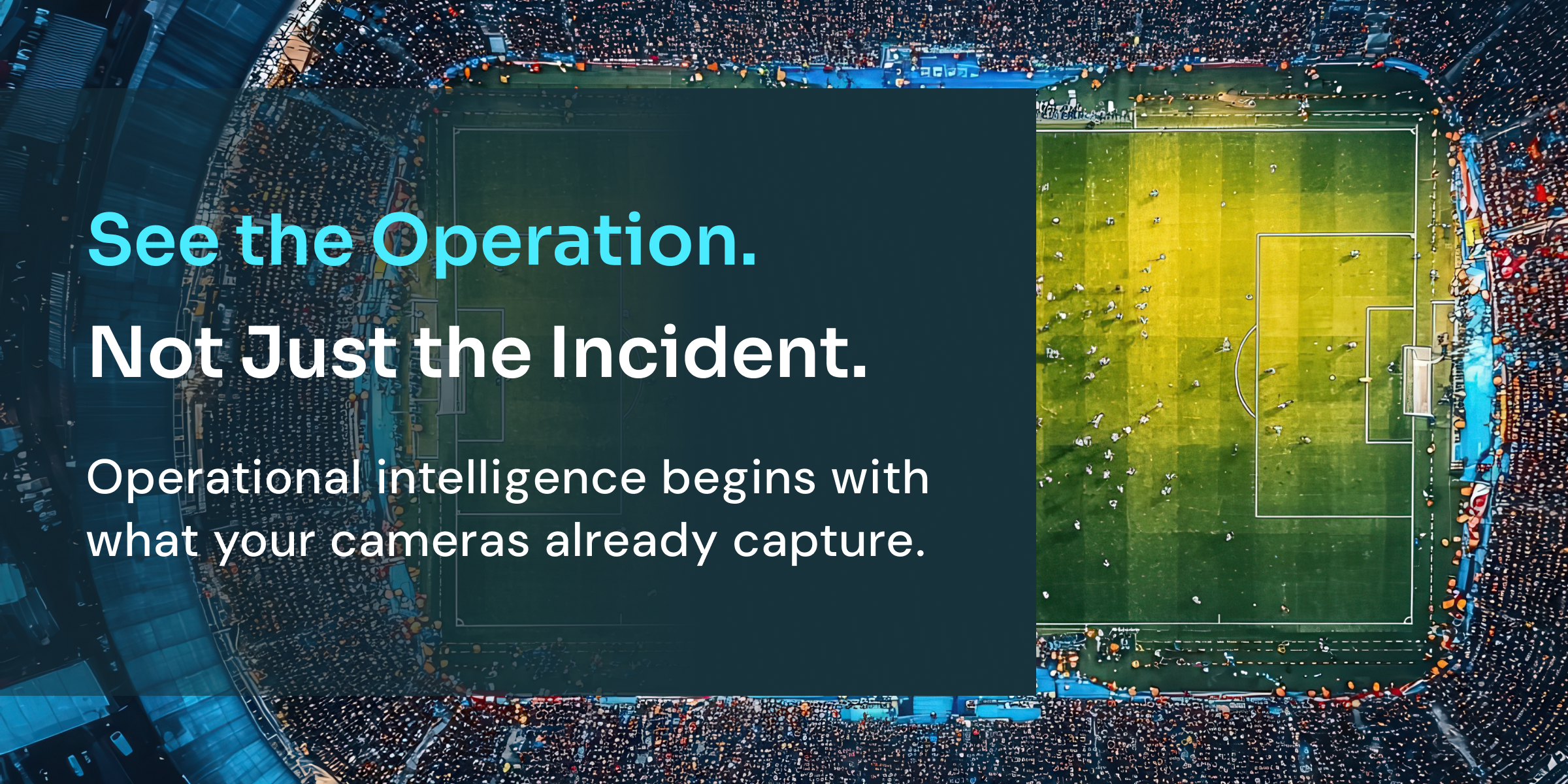
Every Major Event Is Really Hundreds of Smaller Operations
by Team Rhombus, on June 22nd, 2026
Physical SecurityFrom the outside, a major event looks like a single operation.
From inside the command center, it looks very different.
It’s hundreds of entrances opening on schedule. Loading docks receiving deliveries. Credentialed workers moving between restricted areas. Temporary facilities coming online. Parking lots filling, transportation hubs shifting traffic, and security teams coordinating across venues that may be miles apart.
Success isn’t determined by any one of those operations. It’s determined by how well they work together.
That’s what makes securing a large-scale event so challenging. The public experiences one seamless event. Security teams manage hundreds of independent workflows that have to stay synchronized from the first contractor arrival to the last spectator leaving.
And every one of those workflows creates data.
Most organizations already collect enormous amounts of it. Access control records show who entered a space. Sensors report equipment status. Incident logs document what happened. Dashboards measure response times and throughput.
But one of the richest sources of operational insight is often treated as little more than evidence after the fact: video.
Security footage records more than security incidents
Security cameras are installed to protect people, facilities, and critical assets. When something goes wrong, they provide the visual record investigators rely on.
But every camera is also recording something else.
How queues form at entrances.
How deliveries move through secure areas.
How temporary checkpoints operate during peak demand.
How crews adapt when conditions change.
How operators respond to unexpected situations.
In other words, cameras capture how an operation actually runs.
That makes video more than a forensic tool. It becomes a record of the operation itself.
Seeing the connections between independent operations
Large events rarely fail because of one catastrophic incident.
More often, small inefficiencies compound.
A delayed delivery forces a crew to reroute.
An access checkpoint backs up because credential verification takes longer than expected.
A service entrance becomes congested as vendors, contractors, and staff arrive simultaneously.
Individually, these issues may seem minor. Together, they create operational friction that affects safety, staffing, and the overall experience.
Traditional reporting often captures the outcome but not the conditions that created it.
Video fills in those gaps.
Instead of reviewing isolated incidents, teams can compare how similar operations unfold across multiple locations, identify recurring bottlenecks, and understand why one venue consistently performs differently than another.
Every day becomes an opportunity to improve the next
The most effective security organizations don’t just respond to incidents—they learn from daily operations.
Reviewing footage after a shift can reveal patterns that aren’t obvious in metrics alone.
Why does one entrance process visitors faster?
Why do certain loading areas experience repeated congestion?
Why does one procedure consistently require workarounds?
These aren’t just security questions. They’re operational questions.
Answering them helps improve staffing plans, refine procedures, optimize facility layouts, and reduce friction before the next day begins.
Making operational video practical
Of course, none of this works if reviewing footage is difficult.
When video is trapped on individual recorders at separate locations, finding the right moment becomes a project in itself. The operational value disappears because the effort outweighs the insight.
For video to support operations at scale, it needs to be:
- Searchable, so teams can quickly locate relevant moments.
- Centralized, so multiple locations can be reviewed together.
- Accessible remotely, allowing command staff to review activity without traveling between sites.
- Connected to the operational data teams already use to make decisions.
Cloud-managed platforms make this possible by turning thousands of hours of footage into a searchable operational record rather than a collection of isolated archives.
One event. Hundreds of operations.
The largest security operations aren’t really managing one event.
They’re managing hundreds of interconnected activities that must work together under constantly changing conditions.
Security systems already provide visibility into all of them.
The opportunity isn’t simply to respond faster when something goes wrong. It’s to understand how the operation functions every day—and use those insights to make tomorrow run better than today.
That’s when a security system becomes more than a tool for protecting an event. It becomes part of the operation itself.
Learn about AI Analytics.
%20--%3e%3csvg%20version='1.1'%20id='Layer_1'%20xmlns='http://www.w3.org/2000/svg'%20xmlns:xlink='http://www.w3.org/1999/xlink'%20x='0px'%20y='0px'%20viewBox='0%200%20110%20110'%20style='enable-background:new%200%200%20110%20110;'%20xml:space='preserve'%3e%3cstyle%20type='text/css'%3e%20.st0{fill:url(%23SVGID_1_);}%20%3c/style%3e%3cg%3e%3clinearGradient%20id='SVGID_1_'%20gradientUnits='userSpaceOnUse'%20x1='25.325'%20y1='766.725'%20x2='84.725'%20y2='707.325'%20gradientTransform='matrix(1%200%200%201%200%20-682)'%3e%3cstop%20offset='0'%20style='stop-color:%23006F94'/%3e%3cstop%20offset='1'%20style='stop-color:%2300C1DE'/%3e%3c/linearGradient%3e%3cpath%20class='st0'%20d='M106.9,47.5L62.5,3.1c-4.1-4.1-10.9-4.1-15,0L3.1,47.5c-4.1,4.1-4.1,10.9,0,15l44.4,44.4%20c4.2,4.2,10.9,4.2,15.1,0L107,62.5C111,58.4,111,51.6,106.9,47.5z%20M55.5,71.2c-9.4,0.3-17-7.3-16.7-16.7C39.1,46,46,39.1,54.5,38.8%20c9.3-0.3,17,7.3,16.7,16.7C70.9,64,64,70.9,55.5,71.2z'/%3e%3c/g%3e%3c/svg%3e)
Related Articles