Back to blog home
Data Center Physical Security: Controls, Layers, and Modern Systems
by Team Rhombus, on September 23rd, 2026
Physical SecurityIntroduction
Data center physical security works as a connected program in which each control supports the next. Access systems record entry, while linked cameras and sensors provide evidence of security events and environmental threats.
Layered defenses reduce reliance on any single device or checkpoint. Centralized visibility helps operators review alerts, enforce policies, and investigate incidents across one facility or multiple sites. Effective controls protect uptime and provide evidence for compliance audits. They also help preserve customer and tenant trust by showing that access to critical infrastructure remains restricted, monitored, and accountable.
Key Takeaways
- Data center physical security protects infrastructure, data, and uptime against unauthorized access, theft, tampering, and environmental hazards.
- Layered protection combines perimeter barriers, facility access controls, restricted server areas, and rack-level safeguards.
- Video surveillance verifies access events and gives security staff the context needed to investigate incidents.
- Environmental sensors and visitor records extend protection beyond employee access while creating evidence for audits.
- A unified platform connects cameras, access control, sensors, and response workflows, which can reduce manual investigation and simplifies multi-site administration.
What Data Center Physical Security Means
Data center physical security protects infrastructure, stored data, and uptime against unauthorized entry, theft, tampering, and environmental harm. It combines barriers, access control, video surveillance, environmental sensors, visitor procedures, and incident response. Each control should produce records that support investigations and compliance audits.
Cybersecurity protects networks, applications, identities, and data against digital compromise. Physical and cybersecurity programs overlap because connected cameras, controllers, and sensors require encryption, updates, role-based permissions, and secure administration.
A common layered model protects four progressively restricted areas: the property perimeter, building entrances, server rooms or cages, and individual racks. These layers reduce reliance on any single control and can limit an intruder’s movement if one checkpoint fails.
The Layered Security Model for Data Centers
Layered security places controls in concentric rings so one failure does not expose critical equipment. Each inner ring restricts movement more tightly and records evidence for investigations.
The perimeter controls who can approach the facility. Fences, gates, lighting, vehicle barriers, and cameras reduce unauthorized entry and provide early warning. A perimeter failure gives an intruder access to entrances, loading areas, and exterior infrastructure.
The facility layer verifies identity at doors and reception points. Electronic credentials, security staff, visitor records, and controlled vestibules reduce tailgating and credential misuse. A failure here may let an unauthorized person enter shared operational areas.
Server rooms and cages restrict access to people with a specific business need. Separate permissions and video verification limit insider threats and prevent general building credentials from reaching customer or production equipment.
The rack forms the final access boundary. Locked cabinets, door contacts, cameras, and environmental sensors protect individual systems against tampering, overheating, moisture, and smoke. A rack-level failure can affect specific hardware even when the building remains secure. Access logs and sensor alerts should connect across all four layers so investigators can reconstruct an event without comparing separate records manually.
Perimeter and Facility Access Controls
Outer controls delay unauthorized entry and direct people toward monitored checkpoints. Fences define the boundary, while barriers and bollards restrict vehicles. Gates and guard stations verify identity before a person reaches the building.
Electronic access control then limits movement through entrances, server rooms, and cages. Credentials may include cards, mobile access, biometrics, or touchless gestures. Rhombus readers support smart cards, mobile app access, and Wave to Unlock. High-security checkpoints may require two independent factors. A mantrap prevents the second door from unlocking until the first has closed, which can reduce tailgating.
Assign permissions by role, location, and schedule. Connecting access events with video helps operators verify who entered, review denied attempts, and investigate doors held open.
Video Surveillance as a Verification Layer
Video surveillance should verify access events and show what occurred around them. When a credential opens a door, linked footage can confirm who entered, whether someone followed, and what they did afterward. Cameras should cover perimeter approaches, entrances, server cages, and loading docks, with placement based on lighting, viewing angle, and retention needs.
AI analytics can reduce investigation time by identifying people or vehicles and narrowing footage through smart search. Capabilities vary by camera model and deployment. When video, access control, and sensor events share a timeline, operators can review an incident without matching timestamps across separate systems. Cameras still deter some activity, but their main operational value comes from evidence, context, and faster review.
Environmental and Infrastructure Monitoring
Environmental monitoring protects uptime because heat, moisture, water, and smoke can damage equipment or force shutdowns. Temperature and humidity sensors identify cooling problems, while water-leak and smoke sensors provide early warning of infrastructure threats. Vape detection can also flag prohibited activity in restricted areas.
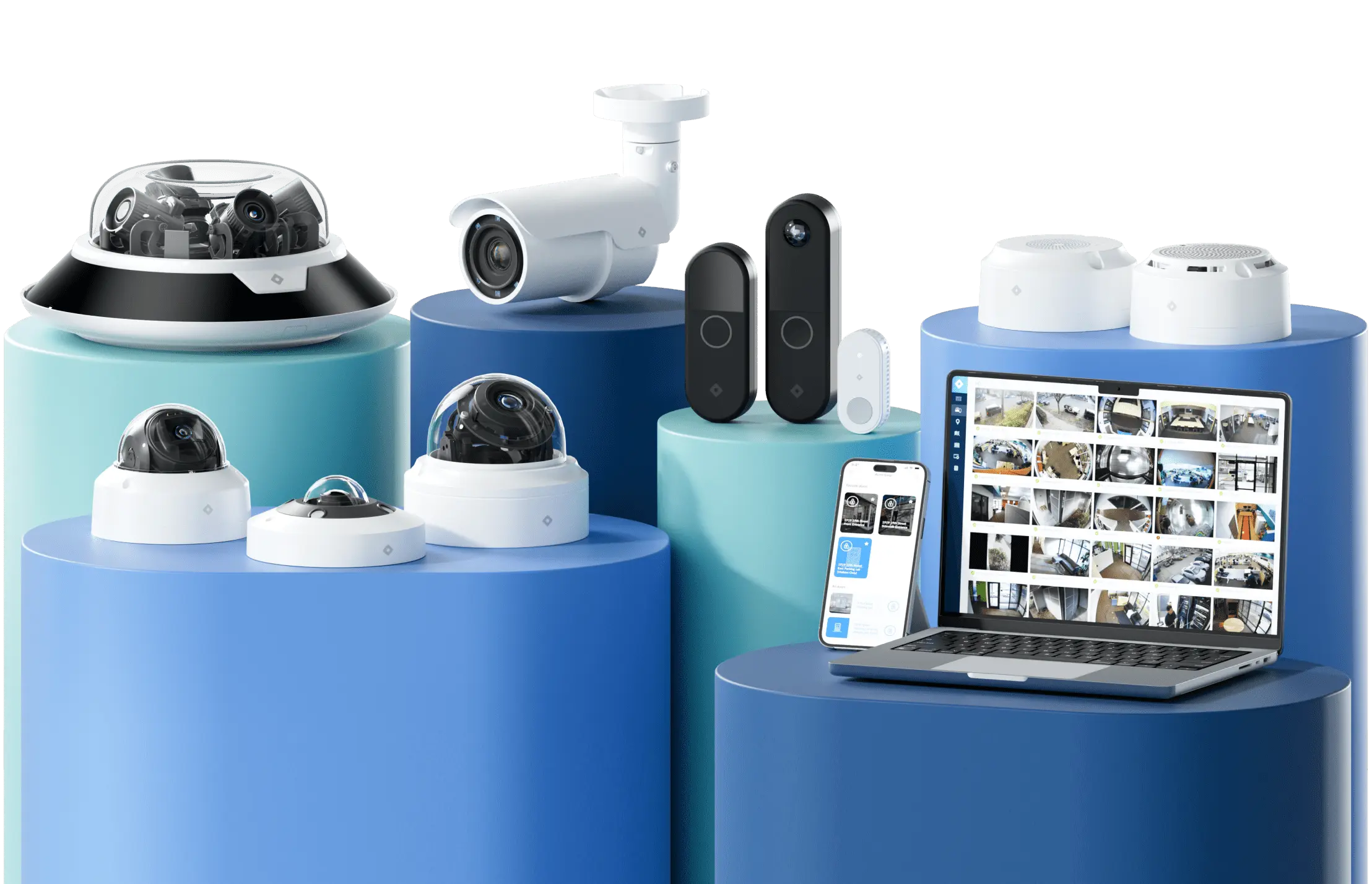
Door contacts extend monitoring to entry points. Rhombus D20 sensors record door activity, while the E50 and E15 environmental monitoring line tracks site conditions. The E50 supports smoke and vape detection, temperature, humidity, air-quality measurements, and selected audio events.
A unified console can connect sensor alerts with access events and nearby video. Security and facilities staff can use that shared record to identify the cause and document who handled the response without reconciling separate logs.
Visitor Management and Vendor Access
Contractors, vendors, and auditors create access risk because their permissions are temporary and their work may require entry into sensitive areas. Visitor procedures should verify identity, record approvals, issue time-limited credentials, define escort requirements, and document departure.
Visitor records should share an audit trail with employee access events. Security staff can then compare sign-in details, door activity, and video during an investigation or audit. With Rhombus Guest, you can manage unified sign-in, view real-time guest status, and record activity in console timeline logs. Native connections to cameras and access control keep visitor activity within the same operational record.
Incident Response and Operational Ownership
Alerts support uptime when a named owner is responsible for acting on them. Security operations should validate access and video alerts, while facilities should handle environmental and power conditions. IT should own network, identity, and integration issues. Each alert needs a severity level, response deadline, primary recipient, backup recipient, and escalation path.
A shared incident plan should specify how staff contain events, preserve evidence, communicate status, and restore operations. Response time becomes measurable through acknowledgement, investigation, containment, and resolution timestamps. Auditors can use those records to confirm that written controls operate consistently.
Consolidated event timelines place door activity, video, and sensor readings in sequence. Investigators can review one incident record instead of matching timestamps across separate systems.
Compliance and Audit Readiness
Compliance frameworks translate physical security requirements into documented controls and evidence. Auditors commonly review access logs, video retention policies, visitor records, incident histories, and proof that administrators receive only the permissions required for their roles. Retention periods and control requirements vary by framework, contract, and jurisdiction.
Audit readiness depends on preserving consistent records across access control, video, sensors, and visitor management. You should document who approved each policy, how often administrators review permissions, and how your organization investigates exceptions.
Rhombus supports compliance planning through granular role-based access controls and detailed audit logging. Rhombus maintains a SOC 2 Type II attestation and states that its products comply with applicable National Defense Authorization Act Section 889 and Trade Agreements Act requirements. These platform attributes can support an audit, but each operator remains responsible for configuring controls and retention policies to meet its obligations.
Comparison Table: Data Center Security Layers
Each security layer should address a defined risk and have a named operational owner.
| Layer | Primary risk addressed | Key controls | Typical ownership |
|---|---|---|---|
| Perimeter | Trespass and vehicle intrusion | Fences, barriers, gates, and lighting | Facilities and security |
| Access control | Unauthorized entry and tailgating | Credentials, mantraps, and door logs | Security and IT |
| Video | Unverified events and slow investigations | Cameras, alerts, and searchable footage | Security operations |
| Environmental sensors | Heat, moisture, smoke, and equipment damage | Temperature, humidity, leak, and smoke sensors | Facilities |
| Visitor management | Untracked vendor and guest access | Identity checks, approvals, badges, and escort rules | Security and reception |
| Incident response | Delayed or inconsistent action | Escalation paths, event timelines, and response procedures | Security, facilities, and IT |
Centralized Multi-Site Administration
Multi-site operators need one administrative view because separate site systems can produce inconsistent policies, duplicate credentials, and fragmented incident records. A central console lets you update permissions once, revoke access across facilities, and review video, access, and sensor events without signing into each site.
Rhombus uses a cloud-edge architecture to manage locations and devices through one console. Automatic updates can reduce manual patching. Rhombus integrations and its open API can connect physical security with identity and operational tools. Centralized administration can reduce repetitive work and simplify cross-site investigations, but you should still assess bandwidth, data residency, resilience, and integration requirements before selecting an architecture.
Evaluation Checklist for Data Center Security Systems
Use these questions during vendor review and proof-of-concept testing.
- Does one console connect access, video, sensor, visitor, and alarm events?
- Can operators manage credentials, policies, alerts, and devices across every site?
- Does the platform preserve local operation during an internet outage?
- Can investigators search a shared timeline instead of reconciling separate logs?
- Does the platform provide role-based permissions, audit logs, retention controls, and exportable compliance reports?
- How does the vendor protect data, issue security patches, and document independent audits?
- Can the system integrate with your identity provider, door hardware, and incident tools?
- Can you add facilities and devices without deploying major server infrastructure?
- Do alerts include clear ownership, escalation rules, and supporting video or sensor evidence?
FAQs
What is data center physical security?
Data center physical security protects facilities, equipment, data, and uptime against unauthorized access, theft, tampering, and environmental hazards. Controls include barriers, access systems, cameras, sensors, visitor records, and response procedures.
Which security standards apply to data centers?
Relevant requirements may come from customer contracts, local regulations, PCI DSS, or an information security program based on ISO 27001. A service provider may also use a SOC 2 report to give customers evidence about the design and operation of its controls. The applicable requirements depend on the data you host, your location, and your contractual obligations.
How many physical security layers should a data center have?
A common model uses four concentric layers covering the site perimeter, building, secure room or cage, and rack. A site-specific risk assessment should determine which controls each layer requires.
Is cloud-managed security safer than on-premises security?
Cloud-managed and on-premises systems can both be secure when configured and maintained correctly. Cloud-managed platforms can simplify updates and centralized administration, but you should also assess encryption, identity controls, outage behavior, data residency, and vendor security practices.
What should a data center security system connect?
A connected system should associate access events, video, sensor alerts, and visitor records. Shared timelines help operators verify incidents and produce audit evidence faster.
Book a Rhombus Demo
A connected physical security program gives security, IT, and facilities leaders one place to review access events, video, sensor alerts, and operational workflows. Our unified cloud-managed platform supports centralized oversight across data center sites while reducing reliance on disconnected point products. Book a Rhombus demo to see the platform in action.
%20--%3e%3csvg%20version='1.1'%20id='Layer_1'%20xmlns='http://www.w3.org/2000/svg'%20xmlns:xlink='http://www.w3.org/1999/xlink'%20x='0px'%20y='0px'%20viewBox='0%200%20110%20110'%20style='enable-background:new%200%200%20110%20110;'%20xml:space='preserve'%3e%3cstyle%20type='text/css'%3e%20.st0{fill:url(%23SVGID_1_);}%20%3c/style%3e%3cg%3e%3clinearGradient%20id='SVGID_1_'%20gradientUnits='userSpaceOnUse'%20x1='25.325'%20y1='766.725'%20x2='84.725'%20y2='707.325'%20gradientTransform='matrix(1%200%200%201%200%20-682)'%3e%3cstop%20offset='0'%20style='stop-color:%23006F94'/%3e%3cstop%20offset='1'%20style='stop-color:%2300C1DE'/%3e%3c/linearGradient%3e%3cpath%20class='st0'%20d='M106.9,47.5L62.5,3.1c-4.1-4.1-10.9-4.1-15,0L3.1,47.5c-4.1,4.1-4.1,10.9,0,15l44.4,44.4%20c4.2,4.2,10.9,4.2,15.1,0L107,62.5C111,58.4,111,51.6,106.9,47.5z%20M55.5,71.2c-9.4,0.3-17-7.3-16.7-16.7C39.1,46,46,39.1,54.5,38.8%20c9.3-0.3,17,7.3,16.7,16.7C70.9,64,64,70.9,55.5,71.2z'/%3e%3c/g%3e%3c/svg%3e)
Related Articles